
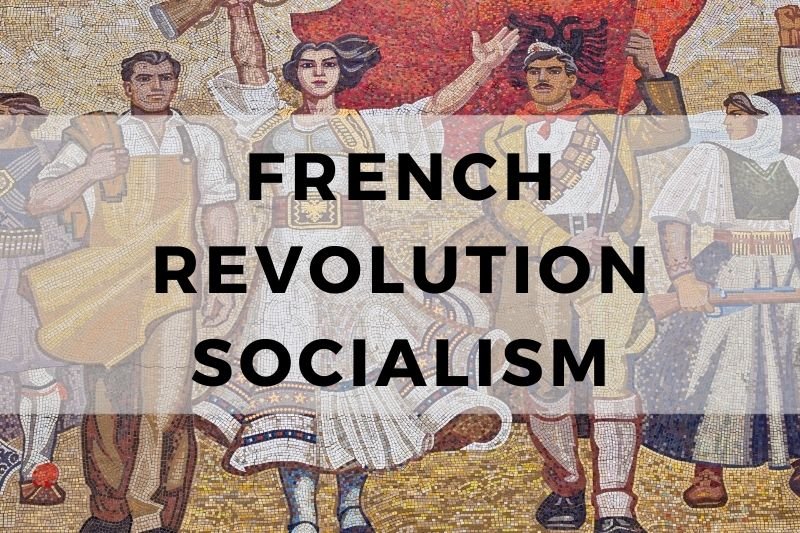
Revolutions are born when people refuse to accept inequality as destiny. The French Revolution of 1789 shattered centuries of monarchy and privilege, igniting a struggle that promised liberty, equality, and fraternity. Behind the storming of the Bastille and the fall of the monarchy lay deep anger at social injustice, crushing poverty, and the arrogance of the elite. Enlightenment thinkers armed citizens with new ideals of reason and rights, fueling demands for radical change. While the revolution did not create socialism, it planted powerful seeds of economic justice and collective equality that would inspire socialist thought for generations to come.
Setting the Stage: The French Revolution (1789–1799)
Political, Social, and Economic Inequalities in Pre-Revolutionary France
France before 1789 was defined by a rigid hierarchy that privileged the few and oppressed the many. Society was divided into three estates: the clergy, the nobility, and the commoners. The First and Second Estates enjoyed exemptions from most taxes, while the Third Estate bore nearly the entire fiscal burden. Peasants struggled under feudal dues, while urban workers faced food shortages and stagnant wages. Economic crises from failed harvests and costly wars deepened misery. Meanwhile, nobles and clergy flaunted wealth and influence, fueling resentment. The structural imbalance of privilege and suffering became the central grievance driving revolutionary anger.
The Role of Enlightenment Ideas in Inspiring Change
Enlightenment thought armed the French people with a moral and intellectual framework to challenge monarchy and inequality. Philosophers such as Rousseau, Montesquieu, and Voltaire questioned hereditary privilege, divine right, and unchecked authority. Rousseau’s idea of the social contract inspired demands for sovereignty resting in the people. Montesquieu’s advocacy of separation of powers attacked absolute monarchy. Voltaire’s critiques of religious dogma encouraged calls for tolerance and secular governance. These ideas did not merely circulate in books; they spread in salons, pamphlets, and popular discussions, shaping a revolutionary consciousness that saw tyranny as both illegitimate and morally indefensible.
Key Events That Sparked the Revolution
The French Revolution erupted through a chain of explosive events that made reform impossible and revolution inevitable. Mounting debt from wars forced King Louis XVI to summon the Estates-General in 1789, giving the Third Estate a chance to voice its grievances. When blocked by the elite, they declared themselves the National Assembly, asserting authority in the Tennis Court Oath. The storming of the Bastille symbolized the destruction of royal tyranny and inspired nationwide uprisings. Soon after, the abolition of feudal privileges and the Declaration of the Rights of Man codified demands for freedom and equality. Violence met resistance, entrenching revolutionary momentum.
The Rise and Fall of the Monarchy
The monarchy collapsed because it failed to adapt to revolutionary demands and lost legitimacy in the eyes of the people. Louis XVI’s half-hearted reforms and reliance on force alienated both moderates and radicals. The king’s attempted escape in 1791 exposed his betrayal of the revolution and destroyed trust in the crown. War with Austria and Prussia worsened suspicion of royal collusion. In 1792, the monarchy was abolished, and Louis XVI was tried and executed for treason. His downfall marked a definitive break with the old order, proving that absolute monarchy was incompatible with revolutionary ideals.
Revolutionary Ideals of Liberty, Equality, and Fraternity
The Revolution crystallized around the ideals of liberty, equality, and fraternity, which redefined the meaning of justice in France. Liberty meant freedom from arbitrary authority and censorship. Equality demanded the end of legal privilege, ensuring all citizens shared the same rights under law. Fraternity expressed solidarity, linking individual rights with collective responsibility to the nation. These principles guided declarations, policies, and revolutionary rhetoric, setting the moral compass of the movement. Although inconsistently applied—women, the poor, and colonized peoples were excluded—the ideals themselves transcended the Revolution, inspiring later democratic and socialist movements to expand their scope and meaning.
Socialism Before Socialism: Early Seeds in Revolutionary France
The Radical Egalitarianism of the Jacobins
The Jacobins embodied radical egalitarianism by demanding political and social equality beyond the limits of moderate reform. Led by figures such as Robespierre, they promoted universal male suffrage, attacked aristocratic privilege, and sought to eliminate economic inequalities through price controls and regulation of grain supplies. Their rhetoric condemned wealth accumulation that threatened the collective welfare. The Jacobins’ policies during the Reign of Terror revealed a willingness to subordinate individual freedom to the survival of equality. Though not socialist in doctrine, their radical egalitarianism foreshadowed later socialist critiques of class power.
Economic Demands of the Sans-Culottes
The sans-culottes pushed the revolution toward economic justice by demanding fair prices, wage protections, and redistribution of resources. These urban workers and small artisans were deeply affected by food shortages and inflation. They pressured the revolutionary government to impose the Law of the Maximum, setting limits on bread prices and wages to protect the poor. Their influence made economic issues central to the Revolution. They also demanded punishment for hoarders and speculators, seeing them as enemies of the people. The sans-culottes demonstrated that political liberty alone was insufficient without material security, shaping the roots of socialist economic thought.
Revolutionary Policies on Land and Wealth Distribution
Revolutionary land reforms sought to dismantle feudal privilege and redistribute property, laying groundwork for economic equality. The abolition of feudal dues in 1789 freed peasants from centuries-old burdens. The confiscation of Church lands and their sale to citizens aimed to redistribute wealth, though in practice much of it went to wealthier peasants and the middle class. Efforts to break up large estates created a vision of society where ownership was more widely shared. These measures did not establish collective ownership, but they represented an early attempt to link revolution with social and economic justice, anticipating future socialist demands.
Calls for Economic Rights and Social Justice
Revolutionary debates expanded the idea of rights to include economic survival and social protection as essential to freedom. Leaders like Robespierre argued that the right to subsistence was as vital as the right to liberty. Discussions of the “right to work” and state responsibility for the poor marked a departure from purely political freedoms. Revolutionary clubs and popular movements declared that citizenship was incomplete without basic economic security. While policies often fell short, the articulation of economic rights planted the notion that social justice required structural changes. This marked a critical step toward the later socialist emphasis on welfare.
The Influence of Popular Revolutionary Clubs
Revolutionary clubs provided the organizational space where egalitarian and proto-socialist ideas were debated, spread, and mobilized. Groups like the Cordeliers and Jacobins connected intellectual theories with the practical concerns of workers and small producers. They became platforms for pushing economic justice into the political agenda, amplifying demands for price controls, land redistribution, and protections for the poor. The clubs acted as incubators for ideas that blended political democracy with economic equality. Their role in mobilizing crowds and influencing policy showed how grassroots activism can transform abstract ideals into actionable demands, foreshadowing the collective spirit central to socialism.
From the French Revolution to Socialism
Gracchus Babeuf and the Conspiracy of the Equals
Babeuf’s Conspiracy of the Equals was the first organized attempt to establish a socialist society based on collective ownership. Gracchus Babeuf, influenced by the Revolution’s promises of equality, argued that political rights were hollow without economic equality. In 1796, he and his supporters plotted to overthrow the government and redistribute land and wealth to ensure all citizens had equal access to resources. Though the conspiracy failed and Babeuf was executed, his ideas marked a turning point. He articulated a program that moved beyond revolutionary rhetoric toward concrete socialist proposals, inspiring later thinkers like Buonarroti, Marx, and Blanqui.
Early Utopian Socialists Inspired by 1789
The Revolution inspired early utopian socialists to imagine societies organized around cooperation, equality, and communal welfare. Thinkers like Henri de Saint-Simon and Charles Fourier looked back to 1789 as proof that radical change was possible. They argued that true equality required reordering economic life, not just political institutions. Saint-Simon emphasized industrial planning for social benefit, while Fourier envisioned cooperative communities that replaced competition with harmony. These utopians drew from revolutionary ideals but criticized the Revolution for failing to address class exploitation. Their visions became foundational in shaping socialist theory, linking revolutionary upheaval with economic transformation.
Revolutionary Economic Measures as Precursors to Socialism
Economic controls during the Revolution foreshadowed later socialist policies by prioritizing collective welfare over market freedom. The Law of the Maximum imposed price ceilings on essential goods to protect the poor from starvation. The requisitioning of grain and state intervention in production signaled recognition of economic rights. Though temporary and often resisted, these measures demonstrated the state’s capacity to regulate the economy for social justice. They revealed tensions between free-market advocates and those demanding equality of subsistence. Socialist thinkers later saw these policies as evidence that economic planning and redistribution could serve as tools for equality and justice.
The Shift from Political Revolution to Economic Reform
The Revolution shifted focus from political representation to economic rights as citizens demanded material security. Initially, the struggle centered on abolishing monarchy and feudal privilege. But as poverty persisted, attention turned to bread, wages, and survival. Popular movements insisted that liberty without subsistence was meaningless. Leaders like Robespierre emphasized that social justice was inseparable from democracy. This evolution marked a crucial step: revolution was no longer only about political participation but also about economic restructuring. By introducing the language of economic rights, the Revolution bridged the gap between political change and the socialist goal of systemic equality.
Saint-Simon, Fourier, and the Vision of Cooperative Societies
Saint-Simon and Fourier advanced the socialist vision by proposing cooperative societies that overcame the failures of revolutionary politics. Saint-Simon argued for an economy managed by industrialists, scientists, and workers to serve society’s needs, not private profit. Fourier imagined “phalansteries,” communities where labor was organized to align with human passions, abolishing exploitation and alienation. Both thinkers criticized the Revolution for ending aristocratic privilege but preserving economic inequality. Their solutions reflected a shift from violent upheaval to constructive reform. They provided a framework where equality, cooperation, and planning could replace chaos, offering a blueprint for socialist movements in the 19th century.
Differences Between French Revolutionary Politics and Socialism
Political Democracy vs. Economic Equality
The French Revolution prioritized political democracy, while socialism demands economic equality as its foundation. The Revolution abolished monarchy, expanded political participation, and created new forms of representative government. However, it left economic structures largely intact, protecting private property and capitalist relations. Socialism, by contrast, argues that true democracy cannot exist if wealth and resources remain concentrated in the hands of a few. For socialists, voting rights alone are insufficient without economic justice. The Revolution proved political rights could be won, but socialism highlighted that without addressing class inequality, democracy risks becoming a privilege of the wealthy.
Individual Liberty vs. Collective Ownership
The Revolution defended individual liberty, while socialism seeks collective ownership to secure equality for all. Revolutionary ideals emphasized personal freedoms such as speech, property rights, and protection against arbitrary authority. Yet these freedoms often favored the propertied classes, leaving the poor vulnerable. Socialism challenged this by arguing that property should serve the community, not private accumulation. Collective ownership of resources, industries, and land ensures that liberty extends beyond the privileged few. The Revolution’s focus on liberty provided a foundation, but socialism extended the idea, insisting that without economic solidarity, liberty remains hollow for the working class.
Short-Term Revolutionary Aims vs. Long-Term Socialist Goals
The Revolution pursued immediate political transformation, while socialism envisioned structural economic change over the long term. The French Revolution aimed to dismantle monarchy, end feudal privilege, and establish rights-based governance. Its urgency was survival and political restructuring. Socialism, however, developed as a response to industrial capitalism, advocating long-term systemic reform through cooperative ownership and redistribution. This contrast reflects differing contexts: revolutionaries fought a feudal monarchy, while socialists addressed capitalist exploitation. The Revolution proved change was possible, but socialism emphasized sustained reorganization of society to guarantee equality beyond the short-lived victories of political upheaval.
The Class Dynamics of the Revolution Compared to Socialist Theory
The Revolution was driven by a mix of classes, while socialism is rooted in the working class as the engine of change. The French Revolution united peasants, urban workers, and sections of the bourgeoisie against aristocracy and monarchy. However, once aristocratic privilege was destroyed, bourgeois interests often dominated, sidelining the poor. Socialist theory later identified this betrayal, emphasizing that the working class alone had the interest and power to abolish exploitation. The Revolution showed how class alliances could topple tyranny, but socialism recognized that without working-class leadership, revolutions risk reproducing new forms of inequality under different elites.
Why the French Revolution Did Not Become a Socialist Revolution
The French Revolution did not become socialist because its aims, conditions, and leadership remained tied to political rather than economic change. The Revolution emerged in a pre-industrial society where capitalism was still developing, making socialist demands premature. Its leaders came largely from the bourgeoisie, who sought political rights and property protection, not collective ownership. Economic measures such as price controls were temporary, not systemic. Without a strong industrial working class to push for socialism, the Revolution settled on political democracy. Later socialist thinkers built on its legacy, but the Revolution itself lacked the material and social basis for socialism.
Lasting Legacy
How 19th-Century Socialists Claimed the Revolutionary Heritage
Nineteenth-century socialists claimed the French Revolution’s heritage to legitimize their struggle for economic equality. They argued that while 1789 destroyed feudalism, it left capitalist exploitation untouched. Figures like Louis Blanc and Auguste Blanqui invoked the Revolution as unfinished, framing socialism as its logical continuation. Revolutionary slogans such as liberty, equality, and fraternity were reinterpreted as calls for collective ownership and workers’ rights. Socialist movements celebrated Bastille Day, honored revolutionary martyrs, and used revolutionary symbols to rally support. By linking their cause to 1789, they presented socialism not as a rupture but as the next stage of revolutionary justice.
Marx’s Interpretation of the French Revolution
Marx saw the French Revolution as a bourgeois revolution that paved the way for capitalism, not socialism. He argued that the overthrow of feudalism empowered the bourgeoisie, who then entrenched their own dominance. For Marx, 1789 demonstrated that revolutions could reshape society but also exposed the limits of political rights without economic transformation. He insisted that socialism required a proletarian revolution, not one led by property-owning classes. Marx praised the radical energy of the sans-culottes but noted their lack of power to seize the means of production. His analysis turned the Revolution into a lesson on class struggle’s unfinished tasks.
The Concept of Permanent Revolution and Its Roots in 1789
The French Revolution inspired the idea of permanent revolution by showing that political change must continuously push toward deeper transformation. The shift from monarchy to republic, then to terror, and later to empire revealed the instability of partial reforms. Revolution did not end with one victory; each stage raised new contradictions. Socialist thinkers later applied this lesson, arguing that once revolution begins, it must extend beyond political change to economic reorganization. Trotsky in the 20th century revived this concept, grounding it in the unfinished trajectory of 1789. The Revolution proved that halting reform leaves inequality intact.
Cultural Symbols Adopted by Socialist Movements
Socialist movements adopted revolutionary symbols to connect their struggles with the legacy of 1789. The red flag, raised by Parisian revolutionaries in 1791, became a central emblem of socialism and workers’ movements. The Marseillaise, born as a revolutionary war song, was reinterpreted as a socialist anthem of resistance. Portraits of Robespierre, Babeuf, and other radicals decorated socialist publications and banners. Bastille Day celebrations served as occasions to affirm solidarity with revolutionary ideals. These cultural borrowings provided continuity, turning the Revolution’s memory into a living resource. By adopting its symbols, socialism anchored itself in a shared tradition of struggle for equality.
Closing Thoughts
The French Revolution did not establish socialism, but it redefined the struggle for justice in ways that shaped its future. By challenging monarchy, privilege, and inequality, it proved that societies could be transformed through collective action. Its radical voices highlighted that liberty without economic security was incomplete, laying a foundation for later socialist critiques. Thinkers such as Babeuf, Saint-Simon, and Marx drew from its lessons to argue for deeper structural change. The Revolution’s ideals of liberty, equality, and fraternity remained unfinished, but they inspired generations to continue the pursuit of social and economic justice beyond 1789.