
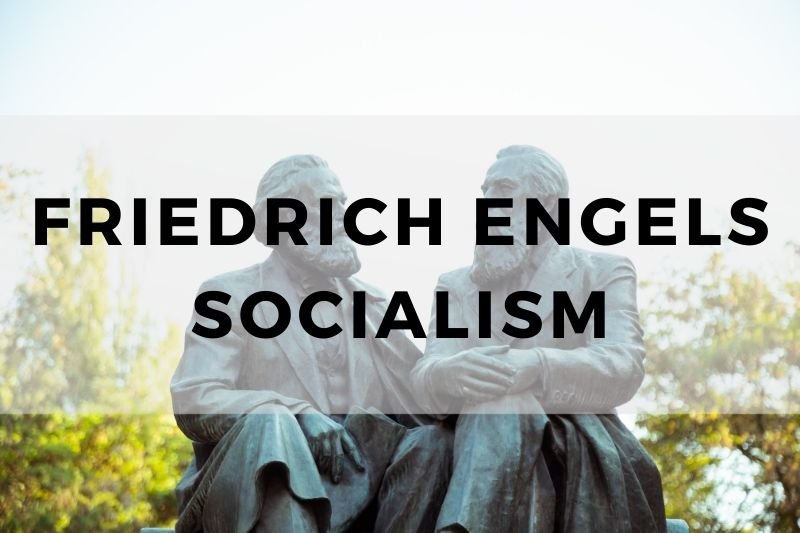
Behind Karl Marx stood a thinker often overshadowed but no less vital: Friedrich Engels. More than just a collaborator, Engels was the driving force who gave socialism clarity, structure, and enduring influence. His sharp critiques of capitalism, combined with his firsthand knowledge of industry, grounded Marxist theory in lived experience. Engels not only co-authored groundbreaking works but also ensured their survival through tireless editing, financing, and promotion. By shaping socialist thought into a scientific framework, he transformed abstract ideals into a movement that could inspire action. To understand socialism’s rise, one must first understand Engels.
Who Was Friedrich Engels?
Early Life and Family Background
Friedrich Engels was born in 1820 into a wealthy textile-manufacturing family in Barmen, Prussia, giving him a unique view of both privilege and exploitation. His father owned factories in Germany and England, exposing Engels to the industrial world at an early age. While expected to inherit and continue the family business, Engels became increasingly disturbed by the harsh conditions faced by workers in his father’s mills. This contrast between his affluent upbringing and the suffering of laborers shaped his lifelong opposition to capitalist exploitation. Engels’ privileged position gave him access to resources, education, and networks that later fueled his revolutionary work.
Education and Political Awakening
Engels’ education exposed him to German philosophy, literature, and radical politics, which laid the foundation for his socialist convictions. Though he never completed a formal university degree, he studied independently, engaging with Hegelian philosophy and critical thought. During his time in Bremen and Berlin, he encountered young radicals who questioned monarchy, religion, and capitalism. Engels began writing articles critiquing social inequality, signaling the start of his political engagement. His exposure to Enlightenment ideals and German Idealism prepared him to merge theory with practice, positioning him as a thinker who could translate philosophy into revolutionary ideas grounded in material conditions.
Meeting Karl Marx
Engels’ meeting with Karl Marx in 1844 marked the beginning of a partnership that would reshape socialist thought. Though they had briefly met earlier, their encounter in Paris solidified a lifelong intellectual and political alliance. Engels had already published “The Condition of the Working Class in England,” which impressed Marx with its empirical depth. Together, they discovered shared convictions about class struggle, capitalism, and the need for revolutionary change. Their collaboration blended Marx’s analytical brilliance with Engels’ practical insights and financial support. This partnership became the cornerstone of historical materialism, forging a unified theory that transformed socialism from critique into strategy.
Transition from Industry to Ideology
Engels’ experience as a factory manager gave him firsthand knowledge of capitalism’s brutality, which he transformed into socialist theory. While managing his father’s textile operations in Manchester, Engels witnessed exploitation, child labor, and poverty at the heart of industrial capitalism. Instead of ignoring these realities, he documented them meticulously, using economic data and personal observation. This direct exposure convinced him that capitalism was inherently unjust and unsustainable. Unlike other theorists, Engels combined lived industrial experience with intellectual analysis. His decision to prioritize ideology over industry ensured that he would not only critique capitalism but also help build a coherent socialist alternative.
Engels’ Contribution to Socialist Theory
Partnership with Marx in Developing Historical Materialism
Engels and Marx jointly developed historical materialism, the theory that economic conditions and class struggle drive historical change. Engels emphasized that material life, not abstract ideals, determines social structures and political developments. He worked with Marx to show how modes of production shape laws, religion, and culture. Engels contributed significantly by clarifying complex economic arguments and grounding them in accessible language. He also provided examples from history to prove that class conflict was the engine of progress. Without Engels’ role in refining and popularizing these concepts, Marxist theory would have remained inaccessible to workers and activists.
Distinguishing Scientific Socialism from Utopian Socialism
Engels separated scientific socialism from utopian socialism by arguing that socialism must be based on historical laws and class struggle, not idealistic visions. Utopian thinkers like Fourier and Owen imagined cooperative societies but lacked a framework for achieving them. Engels insisted socialism should arise from the contradictions of capitalism itself, making revolution inevitable. By stressing economic analysis and class conflict, Engels gave socialism a rigorous foundation. This distinction allowed socialist movements to move beyond moral appeals and into concrete political strategies. Engels’ framing remains crucial in understanding socialism as a scientific and historical necessity rather than a dream.
Analysis of Class Struggle and Economic Systems
Engels analyzed capitalism as a system defined by exploitation, where the bourgeoisie profits by extracting surplus value from the proletariat. He showed that industrial society created a sharp divide between owners and workers, making class struggle unavoidable. Engels highlighted how technological advances under capitalism improved productivity but deepened inequality, concentrating wealth in fewer hands. He linked economic crises to capitalism’s contradictions, showing they were systemic, not accidental. By revealing these dynamics, Engels provided workers with an explanation of their oppression and a vision of how collective action could overthrow the system. His analysis gave socialism strategic clarity.
Engels’ Role as Editor and Promoter of Marxist Thought
Engels ensured Marxist theory survived by editing, publishing, and financing Marx’s works after his death. He carefully compiled volumes two and three of “Das Kapital” from Marx’s notes, giving coherence to ideas that might otherwise have been lost. Engels also defended Marxism against critics, simplifying theory for workers while maintaining intellectual rigor. His financial support of Marx allowed the partnership to thrive, as Marx could focus on research without economic strain. After Marx’s death, Engels became the central figure promoting Marxist ideas across Europe. Without his editorial work and relentless advocacy, Marxism would not have become a global movement.
Key Works by Engels on Socialism
The Communist Manifesto and Its Revolutionary Call
The Communist Manifesto, co-authored with Marx in 1848, became the foundational call for international working-class revolution. Engels played a key role in drafting and sharpening its arguments, ensuring clarity and urgency. The text explained class struggle, the rise of the bourgeoisie, and the inevitable victory of the proletariat. Engels helped frame socialism as a global movement, urging workers to unite beyond national borders. Its concise style and revolutionary spirit made it one of history’s most influential political documents. Engels’ input gave the manifesto its practical edge, making it a guide for organizing and mobilizing socialist movements worldwide.
Socialism: Utopian and Scientific – A Defining Text
In Socialism: Utopian and Scientific, Engels established the distinction between imaginative socialist ideals and socialism rooted in historical materialism. Published in 1880, this work built on earlier critiques of utopian socialists and provided a clear explanation of why scientific socialism was superior. Engels argued that socialism was not a moral aspiration but the inevitable outcome of capitalism’s contradictions. He explained that only class struggle and economic development could bring about true social transformation. The text became essential reading for workers’ movements, offering them a structured understanding of socialism. Engels’ writing ensured socialism could be taught, debated, and applied politically.
The Condition of the Working Class in England – Exposing Industrial Exploitation
Engels’ The Condition of the Working Class in England exposed the brutal realities of industrial capitalism with unprecedented detail. Written in 1845 after his stay in Manchester, the book combined eyewitness accounts, economic data, and social analysis. Engels described the misery of slums, child labor, poor sanitation, and disease among workers. Unlike abstract critiques, his account documented capitalism’s human cost directly. The book shocked readers by revealing exploitation hidden behind industrial progress. It also provided Marx with empirical evidence to support theoretical analysis. Engels’ work remains a cornerstone of social history, linking socialist theory with the lived suffering of the proletariat.
Anti-Dühring – Defending Marxism Against Critics
In Anti-Dühring, Engels systematically defended Marxist theory against the arguments of Eugen Dühring, establishing Marxism’s intellectual authority. Published in 1878, the book critiqued Dühring’s claims on philosophy, economics, and socialism, which threatened to mislead the socialist movement. Engels clarified complex issues such as dialectics, political economy, and scientific socialism. He not only dismantled Dühring’s system but also presented Marxist positions in a way accessible to workers and activists. Parts of the book were later published separately as Socialism: Utopian and Scientific, amplifying its influence. Anti-Dühring solidified Engels’ reputation as Marxism’s defender and made Marxist theory dominant in socialist circles.
Dialectics of Nature – Linking Science and Social Change
Engels’ Dialectics of Nature applied materialist philosophy to natural science, linking social transformation to laws of development in nature. Written during the 1870s but published posthumously, the work examined how dialectical principles operated in biology, chemistry, and physics. Engels argued that scientific progress could not be separated from social and economic systems. By connecting natural evolution with social change, he expanded Marxist theory beyond economics and politics. Though some scientific details later became outdated, the work demonstrated Engels’ ambition to build a unified worldview. Dialectics of Nature highlighted his belief that socialism was consistent with both history and science.
Engels’ Vision of Socialism
The Role of the Proletariat in Revolutionary Change
Engels believed the proletariat was the only class capable of overthrowing capitalism and creating socialism. He argued that workers, bound by shared exploitation, had both the motive and collective strength to challenge the bourgeoisie. Unlike other oppressed groups, the proletariat was directly tied to the production process, giving them revolutionary potential. Engels stressed that only through organized struggle could workers dismantle capitalist power structures. He saw trade unions, parties, and international solidarity as essential tools. For Engels, the proletariat was not just a victim of capitalism but the central agent of historical transformation, destined to reshape society.
Abolition of Private Property and Class Divisions
Engels insisted that socialism required abolishing private ownership of the means of production to end class divisions. He emphasized that private property allowed the bourgeoisie to dominate economic life and exploit labor. By removing private control of factories, land, and resources, socialism would eliminate the root of inequality. Engels did not argue for abolishing personal possessions but specifically targeted property used for profit. He believed that once private property was replaced by collective ownership, class distinctions would disappear. For Engels, this structural change was the foundation of a fair society, where wealth and power were distributed collectively, not hoarded.
Transition from Capitalism to Communism
Engels viewed socialism as a transitional stage leading from capitalism to full communism. He explained that capitalism would collapse under its contradictions, forcing workers to seize power and establish socialism. In this stage, the state would manage production on behalf of society, ensuring resources were distributed fairly. Over time, as class distinctions faded, the state itself would “wither away,” giving rise to communism. Engels stressed that this transition would not be immediate but shaped by material conditions. His framework provided movements with a roadmap, clarifying that socialism was not the end goal but a necessary step toward a classless society.
Importance of Collective Ownership of the Means of Production
Engels emphasized collective ownership as the cornerstone of socialism, ensuring resources served society rather than private profit. He argued that under capitalism, production was social but ownership remained private, creating systemic inequality. By making production collectively owned and democratically managed, society could align resources with human needs. Engels viewed this as the only way to overcome exploitation, unemployment, and recurring crises. He pointed to advances in industry and science as proof that collective planning was possible. For Engels, collective ownership was not just an economic adjustment but the moral and practical foundation of socialist transformation.
Emphasis on Historical and Economic Determinism
Engels argued that historical development is shaped by economic forces, not abstract ideals or individual will. He believed socialism was inevitable because capitalism’s contradictions would drive society toward change. Engels emphasized that social systems collapse when their economic base no longer supports them, making revolution historically necessary. He rejected moral appeals to fairness as insufficient, stressing instead the material inevitability of socialism. This determinism gave socialist movements confidence that their struggle aligned with history’s direction. Engels’ perspective distinguished him from reformists, as he framed socialism not as a choice but as the next stage in human development.
Engels vs Other Socialist Thinkers
Differences from Utopian Socialists Like Fourier and Owen
Engels differed from utopian socialists by rejecting ideal communities and insisting socialism must arise from class struggle and material conditions. Fourier and Owen proposed cooperative societies designed around harmony, but Engels argued they lacked a mechanism for achieving change. He believed their visions ignored the economic realities of capitalism and underestimated the role of conflict. Engels praised their moral passion but criticized their failure to identify the proletariat as the revolutionary force. By rooting socialism in historical materialism, Engels moved beyond imagination to strategy. His critique ensured socialism became a scientific approach, not a speculative dream of reform.
Engels’ Critique of Gradual Reform Approaches
Engels opposed gradual reform, arguing that capitalism’s structural contradictions required revolutionary change, not piecemeal improvements. He warned that reforms such as labor laws or welfare measures could ease suffering but would not end exploitation. For Engels, reform distracted workers from their revolutionary potential and gave capitalism temporary stability. He argued that only by seizing control of production and abolishing private property could workers achieve real liberation. Engels did not reject tactical use of reforms but stressed they must serve revolutionary goals. His critique shaped socialist movements to pursue systemic change rather than settling for limited improvements within capitalism.
Contrast with Anarchist Thinkers Like Bakunin
Engels clashed with anarchists like Bakunin, arguing that abolishing the state immediately after revolution would doom socialism. Anarchists believed centralized authority was inherently oppressive, but Engels maintained that workers needed a transitional state to defend their gains. He saw the state as a tool for suppressing the bourgeoisie and reorganizing production. Without it, he argued, capitalist forces would quickly return. Engels accused anarchists of being unrealistic, ignoring the need for organization and discipline in revolution. This debate highlighted a core divide between Marxist socialism and anarchism. Engels’ position shaped later socialist parties, which prioritized seizing and transforming state power.
Engels’ Position on the Role of the State in Socialism
Engels argued the state must exist temporarily under socialism to manage production and suppress counter-revolution before eventually withering away. He believed capitalism created antagonistic classes that required a workers’ state to dismantle bourgeois power. This state, however, was not meant to be permanent; it would gradually lose its function as class divisions disappeared. Engels saw the state as both a weapon and a transitional structure, distinguishing him from reformists and anarchists. His view balanced practicality with long-term vision. By framing the state as a temporary necessity, Engels provided socialism with a clear strategy for moving toward stateless communism.
Engels’ Relevance in Modern Socialism
Influence on Contemporary Socialist Parties and Movements
Engels’ theories continue to guide socialist parties by providing a framework rooted in class struggle and historical materialism. Many socialist and communist parties still draw from his writings to justify policies on labor rights, wealth redistribution, and state intervention. His emphasis on the working class as the driver of change resonates in movements advocating for union power and social justice. Engels’ insistence on scientific socialism prevents modern socialism from becoming vague moral idealism. By grounding politics in economic analysis, Engels’ legacy ensures socialist movements remain focused on structural change rather than temporary reforms or symbolic gestures.
Application of Engels’ Ideas in Labor Rights Advocacy
Engels’ focus on exploitation directly informs modern struggles for fair wages, union protection, and safe working conditions. Workers’ movements worldwide continue to cite Engels’ analysis of surplus value and industrial oppression. His critique of child labor and unsafe factories parallels today’s debates on sweatshops and global supply chains. Engels showed that labor exploitation is not accidental but systemic, arising from private ownership and profit motives. This insight remains central to campaigns against wage theft, corporate monopolies, and precarious employment. Engels’ influence endures because he offered workers not just sympathy but a structural explanation for their continued oppression.
Engels’ Legacy in Academic and Political Discourse
Engels shaped academic and political debate by extending Marxist theory into history, philosophy, and science. His writings remain a cornerstone in university courses on political thought, sociology, and economics. Scholars continue to analyze his role in defining materialism and class struggle as tools for studying society. Politically, Engels influenced how socialist parties frame their policies, from social welfare to industrial regulation. His work demonstrates that socialism is not only an economic project but also a comprehensive worldview. By bridging theory and practice, Engels ensured Marxism became both an academic discipline and a practical guide for political movements.
Reinterpretation of Engels’ Thought in Modern Contexts
Engels’ ideas are reinterpreted today to address issues like globalization, climate change, and digital capitalism. His concept of historical materialism helps explain global supply chains, corporate monopolies, and shifting labor relations in the 21st century. Environmental movements use Engels’ insights from Dialectics of Nature to argue that capitalism’s exploitation of nature is unsustainable. Digital workers and gig economy activists apply Engels’ analysis of labor exploitation to new forms of precarious employment. These reinterpretations prove Engels’ thought is not frozen in the 19th century but adaptable. His framework continues to provide tools for analyzing new crises created by capitalism.
Criticism and Controversy
Accusations of Oversimplifying Marx’s Ideas
Engels has been criticized for simplifying Marx’s complex theories, making them more accessible but sometimes less precise. While his editing and writing helped spread Marxism, some scholars argue that he omitted nuances in Marx’s economic analysis. Engels’ focus on practical guidance for workers occasionally reduced theoretical depth, creating tensions between scholarship and activism. Critics claim this simplification allowed certain interpretations of Marxism to dominate while sidelining more complex or critical perspectives. Nevertheless, Engels’ clarity also enabled broader engagement, ensuring Marxist ideas reached a wider audience beyond academic circles, balancing accessibility with fidelity to theory.
Critiques of His Views on the Role of the State
Engels’ position on the state has sparked debate, especially regarding its transitional function under socialism. Critics argue that his idea of a temporary workers’ state risks creating centralized power that could persist indefinitely. Anarchists and libertarian socialists contend that any state apparatus inherently reproduces oppression. Engels’ defenders maintain that he envisioned the state strictly as a tool for dismantling class power, not as an end. The controversy highlights the tension between revolutionary necessity and the risk of authoritarianism. Engels’ writings on state power continue to shape debates on how to balance worker control with preventing bureaucratic dominance in socialist movements.
Debates Over Engels’ Influence in Marxist Theory
Engels’ prominence has led some to question whether Marxism reflects Marx’s vision or Engels’ interpretations. His editing of Marx’s works, especially after Marx’s death, gave him significant authority over the presentation of Marxist theory. Critics argue this may have amplified certain ideas while minimizing others, affecting how socialism was understood historically. Some scholars suggest Engels’ practical focus on political activism shaped Marxism into a movement-oriented doctrine, sometimes at the expense of theoretical subtlety. Despite these debates, Engels’ contributions remain foundational, ensuring Marxist thought was codified, disseminated, and applied, even if his influence complicates pure historical interpretation.
Reassessment of Engels’ Scientific and Philosophical Claims
Engels’ attempts to apply scientific principles to socialism and nature have faced both praise and skepticism. Works like Dialectics of Nature aimed to show that social and natural laws operate under similar dialectical processes. Critics argue that some scientific claims were outdated or overextended, questioning their validity. Philosophically, Engels’ materialism sometimes oversimplified complex phenomena, provoking debate among theorists. Despite this, his integration of science and social theory inspired later Marxist thinkers to consider interdisciplinary approaches. Reassessments highlight both the ambition and limits of Engels’ work, recognizing his role in broadening the scope of Marxist analysis while acknowledging areas of contention.
Closing Thoughts
Friedrich Engels remains a pivotal figure in the development of socialist thought. His analysis of capitalism, commitment to the working class, and partnership with Marx created a framework that continues to influence politics, labor movements, and academic study. Engels combined practical experience with rigorous theory, transforming abstract ideas into actionable strategies for change. His writings expose systemic inequalities while offering a roadmap for collective action. Even amid debate and reinterpretation, Engels’ work endures as a tool for understanding economic and social structures. Studying his life and thought provides clarity on the origins, purpose, and ongoing relevance of socialism today.